What to Expect From The Yankee Brass Band in 2026
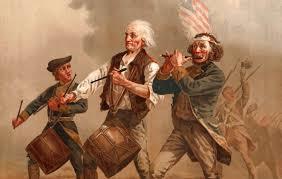
The Yankee Brass band returns to New England in 2026. It is especially exciting to be performing during the United States’ Semiquincentennial, marking 250 years since the Declaration of Independence was adopted. Our concerts will not only be performances of historic American music, but they will also be in locations that were home to many of our nation’s important historic events.
The theme of our season is Brass and Liberty: Music of a New Nation. Musicologists note that, in 1776, bands such as ours did not exist. Bands of the American Revolution included small, official military units with fifers and drummers for signaling and troop morale. Larger ceremonial bands (Harmoniemusik) featuring obes, clarinets, natural horns, and bassoons for parades and officer entertainment were also present. And soldiers brought personal instruments, including violins, guitars, and mouth organs, adding to the diverse soundscape beyond formal military ensembles.
To mark the birth of our nation, we are performing a special arrangement of an original American patriotic song, possibly the second most popular song of the times after Yankee Doodle. Chester is a patriotic anthem composed by William Billings (1746-1800) and sung during the American Revolutionary War. The lyrics of the song became a statement of defiance.
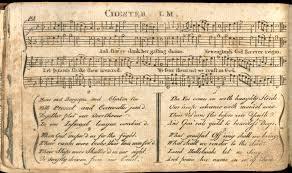
Let tyrants shake their iron rod,
And Slav’ry clank her galling chains,
We fear them not, we trust in God,
New England’s God forever reigns.
After centuries of little change in the manufacture of band instruments, it is interesting to note the rapid development of bands in the United States. In the first half of the 19th century, new designs of brass instruments, especially the invention of the keyed bugle (1810) and the introduction of valves (circa 1815) has a tremendous effect. The keyed bugle was introduced to this country by Richard Willis (? – 1830), an Irishman, who became the director of the West Point band in 1816. By 1823, Willis was leading what some said was “the finest military band in America.” It was this band that performed for the visit of the Revolutionary War hero the Marquis de Lafayette to West Point in 1825. Our performance of Willis’ General Lafayette’s March marks that historic event.
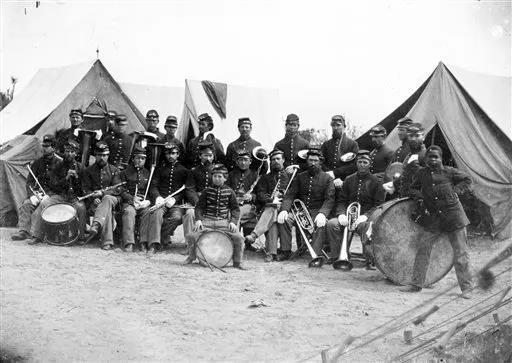
By 1860, bands of brass instruments had become essential parts of military units. When these units enlisted, bands, on both side of the conflict, joined them boosting morale, performing ceremonies, and serving as noncombatant medical assistants (stretcher bearers and surgeons’ assistants.) Three selections from this period are part of this season’s repertoire. The Port Royal Band Books, used by the band of the 3rd New Hampshire Regiment during the period 1861-65 contain 21 volumes of manuscript band music from the Civil War. The band was formed by Gustavus W. Ingalls in July 1861, after receiving executive orders to form a band from New Hampshire Governor Nathaniel S. Berry. It was best known as the Port Royal Band due to an extensive duty tour at Port Royal Island, South Carolina. This collection contains Our Quick Step, composed by Ingalls, and reconstructed for performance this year.
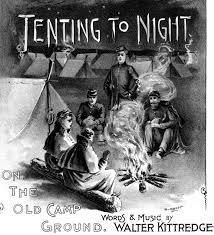
Tenting on the Old Campground was a popular song during the conflict. A particular favorite of enlisted men in the Northern army, it was written in 1863 by Walter Kittredge (1834-1905). A self-taught musician and songwriter from Reeds Ferry, NH (now part of the town of Merrimack), Kittridge’s was a huge success. We are excited to be performing this selection at the Merrimack Historical Society, very close to where the piece was composed and yards away from the site of the ferry which gave the settlement its name.
The 26th North Carolina Band was an organization of intelligent and skilled brass players who were religious men from the Moravian community in Salem North Carolina. Their band books are a resource for band music of the southern armies. Confederate General W. W. Kirkland, an opera fan, commissioned a Quickstep based on Giuseppe Verdi’s Il Trovatore from a Richmond bandmaster for the 26th NC Regimental Band.
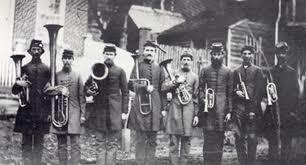
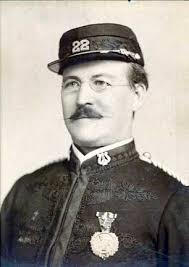
Following the Civil War, military bands transitioned into civic, town, and professional ensembles. They became central to civic and patriotic celebrations. These groups, often composed of veterans, played for parades, funerals, and social functions, popularizing quick-tempo marches and brass music. During the war, the quality of military bandsmen had improved, and they returned to improve their local ensembles. There were also veteran band leaders such as Patrick Gilmore (1829–1892), who had led the band of the 24th Massachusetts Volunteer Regiment during the war. Often called the “Father of the American Band,” Gilmore assumed leadership of the 22nd Regiment Band of New York. While the 22nd Regiment itself was a military infantry unit, this band became internationally celebrated under Gilmore’s leadership, becoming a professional-caliber ensemble that toured extensively. It is often remembered as one of the premier musical ensembles of its era. Yankee will perform Gilmore’s 1872 composition, the Famous 22nd Regiment March.
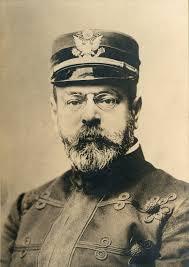
In 1880, John Philip Sousa (1868-1892) became the 17th leader of the United States Marine Band. We perform Semper Fidelis, the march that takes its title from the motto of the U.S. Marine Corps: The trio of this march is an extension of an earlier Sousa composition, “With Steady Step,” one of eight brief trumpet and drum pieces he wrote for The Trumpet and Drum in 1886. The historic Yankee Brass Band will close our concert with a performance of both these works. There will be a few more surprises at a 2026 Yankee concert, but you are guaranteed to learn more about the music of our new nation and enjoy an historic performance of American band music performed some of the best brass players in the country.